
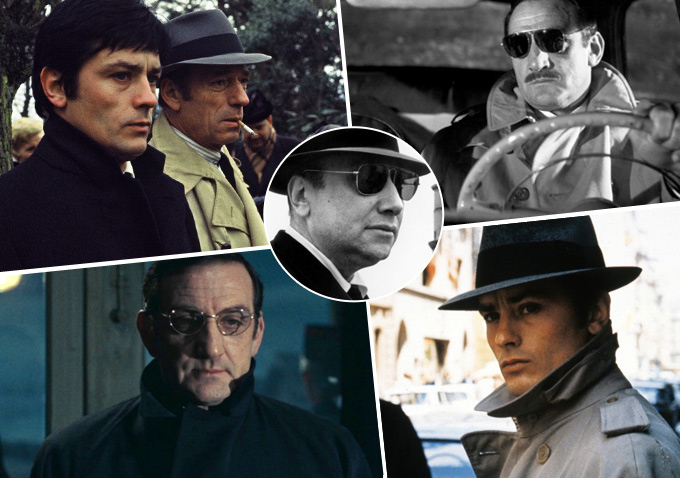
 “Army Of Shadows” (1969)
The final installment of his French occupation triptych (which includes “Le Silence De La Mer” and “Léon Morin, Priest”), Melville’s “Army Of Shadows,” belatedly released in the U.S. 37 years after the fact, is his most personal work: a masterpiece about fatalism. Fictionalized, but based on a true account of underground French resistance fighters in Nazi-occupied France, it is an excruciatingly tense yet superbly minimalist film. Rigorous, economical, and cloaked in cinematographer Pierre Lhomme’s gorgeously bleak penumbra of desaturated blues, browns and shades of gray—anticipating the groundbreaking detached, fascistic look of “The Conformist” by a year— it is also exquisitely crafted: elegance juxtaposed with brutality. But if Melville is often considered emotionally detached based on the cool, aloof gangsters of his crime films, the heartbreaking “Army Of Shadows” provides massive contrast. Led by a who’s-who of contemporary French actors, many of them returning for Melville— Lino Ventura, Simone Signoret, Paul Meurisse, Jean-Pierre Cassel (even Serge Reggiani gets a little cameo)—‘Shadows’ centers on Philippe Gerbier (Ventura), the intrepid head of a French resistance chapter who makes a daring escape, and then with his group, moves between safe houses, murders informers and tries to evade capture. One by one their members are captured, tortured and killed, and while they try to keep moving forward, underneath their stoic mien is the toll that resistance takes on their dignity. An overwhelmingly humanist film about brotherhood, struggle, loyalty and betrayal, “Army Of Shadows” is both profound and tragic. And while it must be near-unbearably sad for those who came of age during this era (as Melville did), its startling bookending gives it universal, historical resonance: opening with a beautiful Arc de Triomphe shot interrupted by German soldiers goose-stepping by, its final sequence details in somber text the cruel fates of each of its players.
“Le Cercle Rouge” (1970)
Beginning with a made-up Buddha quote about the inevitable meeting of men in a red circle, Melville’s penultimate feature film has the power to outlive his entire filmography as his magnum opus partly because of its anti-spiritual introspection, and its probing exploration of the psyche of the criminal mind. “Le Cercle Rouge” brings together legends of the French screen Alain Delon and Yves Montand, with the irreplaceable Gian Maria Volonte as the escapee Vogel, and Andre Bourvil as the inspector who is hunting them, in a story about a jewelry heist. One last job for fresh-out-of-jail Corey (Delon), a chance of starting over fresh for Vogel, and a rehabilitating exercise for the alcoholic ex-corrupt cop Jansen (Montand); the half-hour-long, wordless, and eternally intense heist has now become the stuff of legend, mandatory viewing for anyone interested in witnessing the purest cinematic distillation of the crime genre. Together with long-time DP Henri Decaë, and editor Marie-Sophie Dubus, Melville’s original screenplay and meticulous direction — nurtured to perfection by 1970 — converge in “Le Cercle Rouge” to create an existentialist picture with the desolate vibes of a spaghetti western and a cynical anarchist’s eye for man’s baser instincts. It succeeds as a masterful film in any of the genres it melds (and deserves a top 5 slot on all-time crime film lists), a lot due to its symphonic shot compositions — think of that magisterial pull-back shot early on from the window of the train. But Melville also effortlessly employs symbolism and procedural detail in the compassionate characterization of his anti-heroes here. The theory that “all men are criminals” resonates long after the unforgettable climax, but the bonds of brotherhood forged between Melville’s crooks is an all-too compelling reminder of the humanity that resides within each criminal. “Un Flic” (1972)
As far as fond farewells go, “Un Flic” is an interesting one. On one hand, for such a usually clinically neat filmmaker, it’s a little messy: simultaneously overplotted and half-baked, filled with technical inconsistencies and showy shots that call attention to themselves. It’s not without the heart-stopping set pieces and formal invention that its director is famous for, but it’s also a bit more ragged around the edges than we are used to from such a polished filmmaker. And yet, in spite of all this, “Un Flic” is as good a distillation as any of the motifs and preoccupations that have defined Melville’s work from practically his first film. The final entry in the director’s gangster trilogy – which also included “Le Samourai” and “Le Cercle Rouge” – “Un Flic”, or “The Cop”, casts ‘Samourai”s Alain Delon once again, but this time, flips the archetype for which the actor had become known for on its head; this go-round, Delon plays the cop of the title. As weathered lawman Edouard Coleman, Delon seems somehow harder, and even fiercer than he was in the film that made him famous; no matter how you feel about the film itself, it’s hard to take your eyes off him. The film’s narrative consists of the cop’s dogged pursuit of a notorious thief (Richard Crenna, or Colonel Trautman from “First Blood”) whom he knows all too intimately. Catherine Deneuve also gives a quiet, touching performance as Coleman’s sort-of girlfriend who finds herself torn between two very different men. The film’s shows us the grey, cold, depleted flipside to some of Melville’s more lively depictions of urban life and while overall it may certainly be more uneven than, “Army of Shadows” it’s also an essential piece of viewing for anyone who professes to be a Melville fan.
Melville made three other full-length features apart from the films we’ve covered; 1953’s little-seen and almost entirely forgotten “When You Read This Letter,” 1959’s somewhat stodgy “Two Men In Manhattan” and 1963’s “Magnet of Doom” that saw him re-team with Jean-Paul Belmondo but not quite as successfully as in their other two outings.
We’ve done our best to convince you of this director’s formidable powers and highly influential films, but now it’s up to you, Playlist readers, to continue and add to the conversation. What are your favourite Melville films? Which moments define his cinema for you? Are the three features we skipped more worthy of essential status than any of the 10 we chose? You know where to sound off.
–with Jessica Kiang, Nicholas Laskin and Rodrigo Perez.

