
 “Le Doulos” (1961)
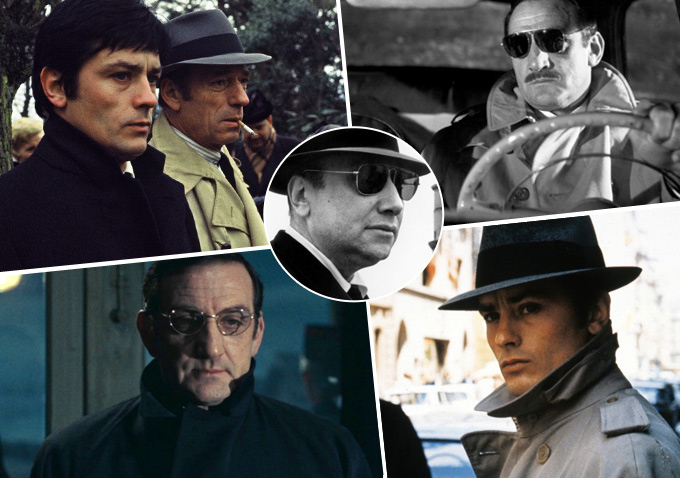
When it comes to the French master’s crime flicks, one could argue that “Bob Le Flambeur” and “Two Men in Manhattan” are a little rough around the narrative edges, and that it’s not until “Le Doulos” when Melville fully answered his true calling. A hardened criminal, in iconic trench-coat and fedora getup, walking under a shadowy pass-way and through the opening credits, confidently signals to anyone who’s watching that Jean-Pierre Melville is the boss of the underworld. Freshly released from prison, Maurice Faugel (Serge Reggiani, nailing the casually cool demeanor) visits old friend Gilbert (Rene Lefevre), kills him, and steals his stash from a recent heist. The plot unravels when Silien (Jean-Paul Belmondo, criminally charming as usual) is introduced as another thief who is suspected of being a police informant (‘doulos’ is slang for ‘rat’), and a wounded Maurice goes into hiding after a bungled burglary ends with him killing a cop. Famously influencing Quentin Tarantino‘s “Reservoir Dogs” when it comes to gangsters who love a good chat, “Le Doulos” has unpredictable violence lurking in every shadow, and finely-tuned characterization of the unwritten code of honor amongst thieves that Melville would go on to perfect in the late 60s and early 70s. It also contains one of the more marvelous shots of Melville’s career; a clandestine super long-take of a conversation in police headquarters, where the camera follows Jean Desailly‘s Commissaire Clain as he attempts to turn Silien. It’s a technical highlight in a film full of uncompromising personalities and tragic plot twists, adding further proof that what we’re watching here is Melville’s first pulpy masterpiece of crime.
“Le Deuxième Souffle” (1966)
Titled “Second Breath” or “Second Wind” in English, Melville’s ninth film is really more the story of a desperate last gasp. But in another way, the name is apt: as theorist Adrian Danks suggests in his excellent Criterion essay, “Le Deuxième Souffle,” Melville’s most commercially successful film to that point and yet one of his most underseen today, marks an interesting pivot point between the pulpy investigation into codes of masculinity and criminality of earlier pictures like “Bob le Flambeur” and “Le Doulos,” and the terse, philosophically ambivalent atmospheres of his later crime films. In fact, without ever compromising its linearity, it feels like several films: a prison escape movie, a policier, an underworld crime flick, a heist movie and occasionally even a lovers-on-the-run narative all rolled into one seamless, evocative whole. A wordless prison break sequence happens before and during the titles, as Gu (Lino Ventura) escapes jail in a series of shots so angular and asymmetric they’re almost abstract. Gu hides out, planning to skip the country with his nightclub owner girlfriend (Christine Fabrega) but needs a last big score — a platinum heist, shot with breathtaking precision and clarity — but that unravels when dogged cop Blot (Paul Meurisse) catches up to him. Melville attains a flawless lack of sentimentality: Gu may have an oddly noble code of loyalty — indeed it’s his fatal flaw — but he is a remorseless killer at the same time, not to mention a fool for pride. A neglected masterpiece, ‘Souffle’ was also Melville’s last film in black and white and is stunning farewell to monochrome, featuring some of the most consummately, coolly beautiful shotmaking (DP: Marcel Combes) of his career. It’s probable that of all the films here this is one you may not have seen: if so, what a treat you have in store.
“Le Samourai” (1967)
A celebration of style, cool and, above all, meticulous craft, “Le Samourai” is still, after all these years, one of Melville’s definitive films. It’s a coiled, immaculately controlled piece of juicy crime-movie storytelling that remains especially notable for its spartan narrative, unglamorous depiction of crime and its consequences, and the iconic, star-making performance from leading man Alain Delon, who plays the baby-faced killer Jef Costello. Costello is an assassin for hire who lives in a single-room Paris apartment that is pretty much empty, save for the perpetually singing canary that sits in the corner. Over the course of the film, Costello arranges his murderous tasks with the painstaking thoroughness of a Swiss watchmaker: there is no detail, however seemingly insignificant, that he has not considered. Costello creates an ironclad alibi, murders a nightclub owner and evades the pursuit of an overzealous police inspector (Francois Perier) who wishes to see him brought to justice. As a pure mood piece, “Le Samourai” is nothing short of intoxicating, like a dream with its own insistent and bizarre logic — one you don’t want to wake up from. It is uncluttered, bereft of unnecessary exposition, as lean and dangerous and unsentimental as its hero. Melville’s crime classic has gone on to influence countless other films, including Jim Jarmusch’s loving hip-hop pastiche “Ghost Dog: Way of the Samurai,” Nicolas Winding Refn’s gory neo-noir “Drive” and practically every movie Michael Mann has ever made about a tortured badass who must adhere to a code of duty. And yet few of these subsequent films, as great as some of them are, can capture the majesty of this picture, which sees Melville operating at the peak of his powers. This is sinuous, powerful, crime storytelling: as sharp as the edge of a switchblade, and just as deadly.

