
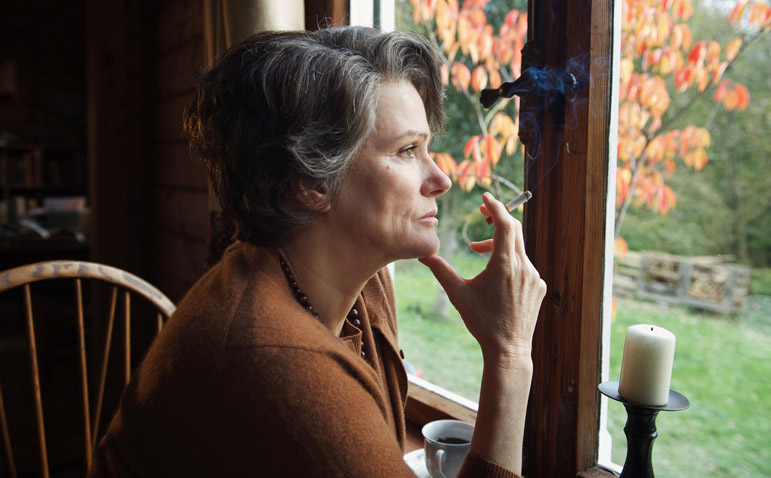
 “Thinking is a lonely business,” utters Martin Heidegger to his student and lover Hannah Arendt; Margarethe von Trotta‘s biopic of Ms. Arendt certainly hammers the point home. Barbara Sukowa, who portrays the titular thinker/philosopher/theorist, is possessed with an ability to make her frequent smoke breaks and lounging sessions both elegant and compelling. You ponder the ongoings of Arendt’s mind, the same mind that notoriously coined the phrase “the banality of evil” in response to having heard the trial of Adolf Eichmann, an instrumental Nazi and an engineer of the Holocaust.
Eichmann, captured in Argentina by Mossad and delivered to Israel and Jerusalem to stand trial, doesn’t so much fascinate Arendt as provoke her intellectually; his perceived normality is a far cry from the psychopathic profiles the Nazi movers and shakers cut, with Hitler in particular practically frothing at the mouth in recorded footage. von Trotta wisely cuts to the actual trial instead of a recreation, trusting the images to make the case for themselves. Despite the attempts of the film steering us in a certain direction, it is still difficult not to see the real Eichmann and feel a tinge of hate, a rising anger.
The film zeroes in on Arendt’s reporting on the Eichmann trial, culminating in the publication of “Eichmann in Jerusalem,” a landmark book that stirred up a firestorm by suggesting that Jewish leaders were in part responsible for the extermination of their own people. Arendt was also put off by the theatrics of the trial, something the actual footage certainly demonstrates, despite selective editing. Her journey and the book writing process that follows (intercut with oddly off-kilter scenes set inside The New Yorker newsroom, where everyone machineguns their dialogue and might as well wear a sign around their necks that proudly proclaims “American journalist caricature, circa mid 20th century”) unfolds at a leisurely pace, full of furrowed brows and intellectuals trading blows over wine. It’s a slow crawl toward the final scenes of Arendt defending herself in a classroom and von Trotta luxuriates in the company of Sukowa, who gives finds an emotional center in the steely, logical Arendt.
Anchored by a small group of close friends and a strong bond with husband Heinrich Blücher (a dignified and warm Axel Milberg,) Arendt watches her few alliances fray after the release of the book. Castigated as a self-hating Jew at worst and woefully cold at best, she is left largely to her own thoughts, though she does attempt to bridge friendships that fall apart, and one later scene in Israel offers a sad reflection of ideals clashing despite a love between two people. Although burdened by a slow start, “Hannah Arendt” finds its footing in dispensing Arendt’s ideas verbatim, something that Sukowa is able to imbue with real power. This Playlister is unfamiliar with much of the historical background and the biographical details of Arendt’s life, but the film does not require you to be. While it could easily be shorter and move a bit faster, especially at the beginning, it appears to move at a speed that’s true to the heroine’s thought process. You see the early inklings cross Sukowa’s face and then grow until she is willing to stand up for her views unabashedly.
It’s hardly telegraphed, since we largely have to contend with multiple scenes of Arendt simply thinking, but somehow it works. The same can be said for the film, handsomely assembled but frequently staid. If this portrait is true to Arendt, then let it stand. As a filmic examination of an extraordinary mind, it doesn’t breathe much life into the frame. [B-]

