
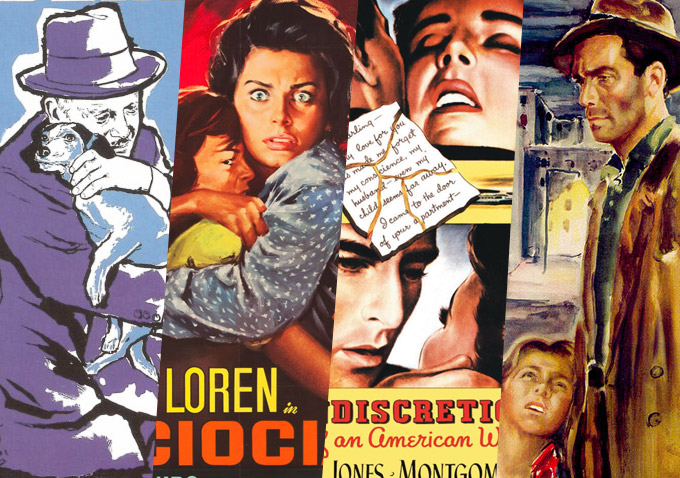
 “Indiscretion of an American Wife”/”Stazione Termini” (1953)
There are two distinctly different versions of De Sica’s 1953 romantic melodrama starring Jennifer Jones and Montgomery Clift (at his gorgeousest), but surprisingly, both are pretty great, especially if you come to the shorter, inferior, Hollywood version ‘Indiscretion‘ first. Quite the Harvey Weinstein of his day, superproducer David O. Selznick spearheaded the teaming of De Sica with two U.S. stars, but the resulting 89-min real-time film, “Stazione Termini” was not at all to Selznick’s liking. So he cut over 20m out (meaning he had to shoot a separate short “Autumn in Paris” to bring the package up to distributable length) mainly by shearing away a great deal of De Sica’s trademark ground-level observations. The joins show particularly in the scene where Jones’ unfaithful wife and mother give chocolate to some kids: when the camera’s on them, it’s could be an outtake from “Bicycle Thieves” (complete with potentially excessive sentiment). But when it cuts back to their patroness eyeing them limpidly, it feels pointed: America as benevolent provider. Still, castrated and cauterized though Selznick’s ‘Indiscretion’ is, it can’t conceal the genuine emotion, and surprising sexiness of this doomed romance, as Monty and Jones battle their irresistible attraction in Rome’s main train station, while life thrums and buzzes all around.
“The Gold Of Naples” (1954)
De Sica began his career as an actor in light comedies in the 1920s, so perhaps it’s not so surprising he returned to that milieu for a palette cleanser after directing a slew of uncompromising neorealist dramas. Co-writing (with Cesare Zavattini, and Giuseppe Marotta) as well as directing, in 1954 he turned in the first of many anthology films in “The Gold Of Naples,” a collection of 6 stories, some comic, some tragic, set in his Italian hometown. It’s certainly a lighter affair then his classics, but its aesthetic — black and white, raw and relatively unadorned — feels of a piece with his more famous films and Sophia Loren scored one of her first starring roles in “Pizza On Credit,” about an unfaithful wife trying to retrieve her missing wedding ring from her lover before her pizza-making husband can find out. She makes it one of the movie’s most entertaining segments. De Sica himself stars in “The Gambler” an amusing tale about the dignified scion of a rich family who’s been cut off from the coffers. “The Racketeer,” about an ungrateful mobster turned overstaying houseguest is also comical, while “Theresa,” about a prostitute duped into even more dishonorable marriage gives a poignant edge to the frivolity. European omnibus movies became all the rage in the 1950s and ’60s, but form a most uneven genre — many masters (even Fellini) stumbled hard in this format. Which makes the sturdy, diverting “Gold Of Naples” a near-gold standard. (And though originally released in the U.S. as only four shorts, Film Forum is screening the uncut version with all six segments.)
“Two Women” (1960)
After vacillating between frivolous comedies, portmanteaus and heavy dramas, De Sica went back to neo-realism one last time of consequence. “Two Women” is a harrowing loss of innocence tale set during WWII, starring Sophia Loren, Jean-Paul Belmondo and a young Eleonora Brown. Cesire, a widowed shopkeeper (Loren) and her devout 13-year-old daughter (Brown) flee Rome after the Allies bomb the city and find refuge in the village where Cesira was born. During their journey they face all kinds of obstacles but Cesira does whatever she can to protect her young daughter. Belmondo plays the man who falls for Cesire but just as her daughter begins to see him as a father figure, starving German troopers roll into town. The women try to flee, but are captured, and — this is where the movie becomes utterly harrowing — both are gang-raped. The traumatized young girl detached from reality, her mother mourns and they both struggle to move forward. The film meanders in the middle, but builds to a devastating finale and deservedly won the Best Actress Oscar for Loren, so it’s a little sad it has been so neglected (even now, poorly dubbed, low-quality transfers are the best you can find). Hopefully it’s just a matter of time before someone (ahem, Criterion) lovingly restores this underrated gem.

