
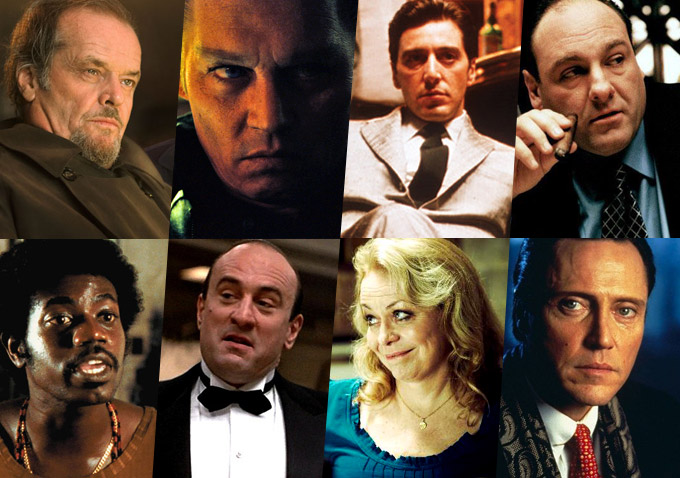
 Frank Costello (Jack Nicholson) in “The Departed”
Jack Nicholson’s beantown psycho from Martin Scorsese’s “The Departed” is a man of savage, insatiable tastes who’s as likely to push a prostitute face first into a mountain of coke as he is to wave around a severed hand just to make a point. Costello is also loosely based off James “Whitey” Bulger, but even if the star of “Black Mass” looks genuinely freaky with his colorless eyes and balding pate, it’d be hard for the Deppster to come within spitting distance of Nicholson’s work here, which goes so far over the top that it practically qualifies as performance art. Scorsese’s tale of rats and roaches in fearful, post-9/11 America has a mean undercurrent of mordant comedy, and some of Nicholson’s best scenes — like when he gives Matt Damon’s duplicitous mole a nasty surprise in a porno movie theatre — occur when the actor is allowed to let loose. In a film graced with gifted actors giving nuanced performances, Nicholson flies gloriously off the handle here, but he’s never anything less than a joy to watch.
Michael Corleone (Al Pacino) in “The Godfather Part II”
Although Al Pacino’s subsequent turns in “Scent of a Woman” and “Glengarry Glen Ross” gave him a reputation as a perpetual overactor, who can forget that he did such grand yet understated work in the 1970s for directors like Sidney Lumet (“Serpico” is an undeniable highlight) and, of course, in Francis Ford Coppola’s lush, funereal “Godfather” pictures. The second film in Coppola’s operatic saga of the Corleone family marks an interesting turning point: while his Michael Corleone was, at least on the surface, fundamentally good in the first film, something rotten seems to have taken over in ‘Part II,’ so here Pacino smolders with simmering resentment, without once letting histrionics take over. He’s all the more terrifying for what he doesn’t say, for what his face doesn’t even betray with a flicker. His depiction of Michael as a man who all-too-willingly assumes his father’s reins as a ruthless murderer is one of the actor’s finest accomplishments, as well as one of the most nuanced and intelligent depictions of a gangster slowly losing whatever morals he once had.
Li’l Ze (Leandro Firmino) in “City of God”
Fernando Meirelles and Katia Lund‘s “City of God” is electric cinema, but it’s also notable for being one of the most unsentimental portraits of the criminal life ever filmed. There is no sense that the gangsters in this film are anything other than stupid, desperate young men, blindsided by the need for mentorship and respect, and willing to resort to the basest means of human behavior to achieve what they seek. Nowhere is this more apparent than in the film’s portrait of Li’l Ze, a sadistic drug-pusher who takes a disturbing pleasure in watching his victims squirm under the gun. This fuck-the-world nihilism reaches its uncomfortable culmination in a deeply upsetting scene where Ze taunts a child who looks to be no older than seven before shooting him in the foot and forcing one of his lackeys to finish him off. It’s brutal stuff, but Ze’s nightmarish laugh sticks with you, even overriding the many other harrowing scenes in “City of God.” It’s a film, and a performance, that strips the gangster genre of any and all romantic notions, all while remaining stylish, intelligent, and raw.
Harold Shand (Bob Hoskins) in “The Long Good Friday”
John Mackenzie‘s terrific 1980 film, “The Long Good Friday,” remains the pinnacle of the British gangster film, and Hoskins, as Harold Shand, a London gangster wanting to go legit, remains the pinnacle of the British movie hoodlum (though Tom Hardy‘s not bad in the upcoming “Legend“). Shand, trying for one last huge score before going straight, has a property development scheme in place for London’s Docklands, in the hopes that it might serve as the site for a future Olympics. But he is stymied by an unknown enemy (probably the IRA), who causes the U.S. mafia to pull out of the agreement, leaving Shand high and dry and desperate to hold his crumbling empire together. It’s a film that sums up its era — timed to the arrival of Margaret Thatcher in government, Shand is the kind of figure who would have flourished under her. But political subtext aside, it’s also simply a gripping thriller, with a star-making performance from Hoskins (his final scene, as he’s confronted by an IRA hitman, Pierce Brosnan in his first screen role, is a masterclass) that shows both the peaceful, honorable man Shand wants to be, and the psychotic thug that lies underneath.
Marcellus Wallace (Ving Rhames) in “Pulp Fiction”
“Fuck Pride. Pride only hurts. It never helps.” So sayeth the feared Marsellus Wallace, the silky-voiced crime capo who acts as one of many moving parts in Quentin Tarantino’s profane, epochal “Pulp Fiction”. As Wallace, Rhames has an ingratiating smoothness that is decidedly at odds with the more blustering, macho energy that a lesser actor might have delivered in the role. Marsellus, in spite of clearly being in charge of some faction of a criminal empire, seems curiously nonplussed throughout most of Tarantino’s chatty, twist-filled narrative. It’s not until he finds himself at the mercy of two sadistic redneck thugs — we all remember that “Gimp” scene — that we get to see the beast unleashed. Rhames, ever the canny and intuitive performer, feels no need to overstate the man’s ruthlessness. It’s all implied, and doubly effective in that regard. Never have the words, “I’m gonna get medieval on your ass,” sounded so sexy, or so cool, or so goddamn threatening. Rhames is frequently overshadowed by the more popular and flashy work of co-stars John Travolta and Samuel L. Jackson, but he makes a memorable heavy in Tarantino’s most beloved picture.
Nucky Thompson (Steve Buscemi) in “Boardwalk Empire”
Twenty or so years ago, Steve Buscemi might have been tasked to play the knuckle-cracking, motor-mouthed henchmen to a mob moss. It’s doubtful that anyone would have had enough faith in the actor’s cachet to ask him to play a bonafide criminal kingpin. And yet, that’s exactly what Terence Winter did with his sprawling, problematic prohibition saga “Boardwalk Empire.” In the HBO series, Buscemi plays Enoch “Nucky” Thompson, who, like many a gangster before him, struggles to reconcile the legitimate elements of his business with his, shall we say, off-the-books habits. Winter’s show doesn’t get points for originality, and, too frequently, it falls back on mere macho bluster instead of finding new and inventive ways to push the narrative forward. But Buscemi’s brainy, subtle turn as a conflicted dealmaker during America’s most decadent decade frequently gives the material a big boost, even convincing us to give this slot to him, amongst so many other great hoodlum honchos in this show, from Stephen Graham‘s nascent Al Capone to Michael Stuhlbarg‘s genius cold-fish Arnold Rothstein. Buscemi defines the kind of gangster who’s more at home greasing the palms of business rivals than exacting brutality on his foes, yet still towers across this show.
Tony Montana (Al Pacino) in “Scarface”
It’s been argued that Al Pacino’s berserker turn as megalomaniacal cocaine cowboy Tony Montana in “Scarface” — a remake of a Paul Muni-starring film from 1932 that substituted cocaine for prohibition-era alcohol trafficking, as well as an unfortunately cannibalized staple of much mid-90’s gangster rap — is a notable example of chewing the scenery. While this claim is, on the surface of things, hard to deny, the point itself seems reductive when you consider how stupidly, unapologetically over-the-top Brian De Palma’s whopper-sized mobster saga truly is. Pacino’s hammy turn as a Cuban refugee who gets rich selling white stuff on the sandy shores of 1980s Miami is only as opulent and exaggerated as the film that surrounds it. Pacino’s is a performance that has spawned an inordinate number of catchphrases and remains a dizzying career high, especially for being the polar opposite to his restrained turn in “The Godfather Part II,” yet in broadly the same arena. It may not be your cup of tea, and it occasionally resembles a splashily-colored slasher movie — see the infamous chainsaw scene — but ask frat boys and rap stars around America, and Tony Montana is the bad guy you want to say goodnight to.
Leo O’Bannon (Albert Finney) in “Miller’s Crossing”
It’s a long way from the flamboyant Belgian detective Hercule Poirot to Leo O’Bannon, but Albert Finney spans that whole immense distance. As the polished Irish American mob boss, Finney handles every situation with the same finesse he would a clue upon the Orient Express, or a shot glass in “Under the Volcano”. In the Coen Brothers’ 1990 film, Finney is immersed in a detailed pastiche of the 1920s gangster flick and its Prohibition-era illicit watering holes, where he finds himself in a power struggle with his nemesis, Italian American mob boss, Johnny Caspar. Between the two bosses is O’Bannon’s right-hand man and general factotum, Tom (Gabriel Byrne), who is sleeping with O’Bannon’s girlfriend and colluding with Caspar. O’Bannon, who could really be a kind of predecessor to Don Corleone, must face the ethical complexities of friendship and loyalty, all while controlling dirty cops and trigger-happy enemies. A perfect execution of the Coen’s rat-a-tat dialogue and neo-noir comedy, Finney is of paramount importance to a great film that manages to somehow to be underrated in their canon.
Wilson Fisk (Vincent D’Onofrio) in “Daredevil”
Vincent D’Onofrio has been an underrated performer for longer than most millennials have been alive: funny to think there’s a generation that knows him best from “Law and Order.” The diversity of his roles has been impressive, but more often than not his solid work somehow blends into the film or is unjustly overshadowed by whichever handsome actor is playing the good guy (see this summer’s “Jurassic World”). “Daredevil” creator Drew Goddard had something else in mind though for his Marvel show. From episode one it’s clear that Wilson Fisk is as much the star as Matt Murdock. And damn, does D’Onofrio run with the character. Fisk, first and foremost, is a man; a human being full of passion and love and loneliness. But in D’Onofrio’s hands, Fisk is also a monster. A force of nature. He’s equally as compelling and complex as Murdock, though Fisk, shockingly, seems to get the more emotional role: his relationship with Toby Leonard Moore’s James Wesley is as powerful and deeply realized as anything else on TV this year. D’Onofrio is heartbreaking, magnetic, and almost too relatable for our own comfort.
Al Swearengen (Ian McShane) in “Deadwood”
In the fictional tale of the actual town of Deadwood, South Dakota, Ian McShane’s diabolical turn as Al Swearengen is simply one of the most memorable and ruthless villain/antihero roles in television history, because, as any fan of the show knows, despite Al’s meticulously cunning, murderous ways, he might be the most likeable guy in town. The owner of The Gem, Deadwood’s original brothel and whiskey joint, Al spends his days (and the majority of the show’s scenes) in his top-floor office or its adjacent balcony overlooking new developments (not to mention enjoying a bird’s-eye view of his enemies’ movements). Amidst the animal feces, frontiersman chatter, and rampant disease, Swearengen’s quick-wit and uncanny ability to solve (or create) problems are unmistakable, particularly in his encounters with Sheriff Seth Bullock. Swearengen and Bullock (the ever-intense Timothy Olyphant) are sometimes dramatic foils, sometimes confidants, sometimes throwing-each-other-over-a-balcony types, and it’s these brilliantly written encounters especially that make McShane’s terrific and domineering performance so memorable.

