

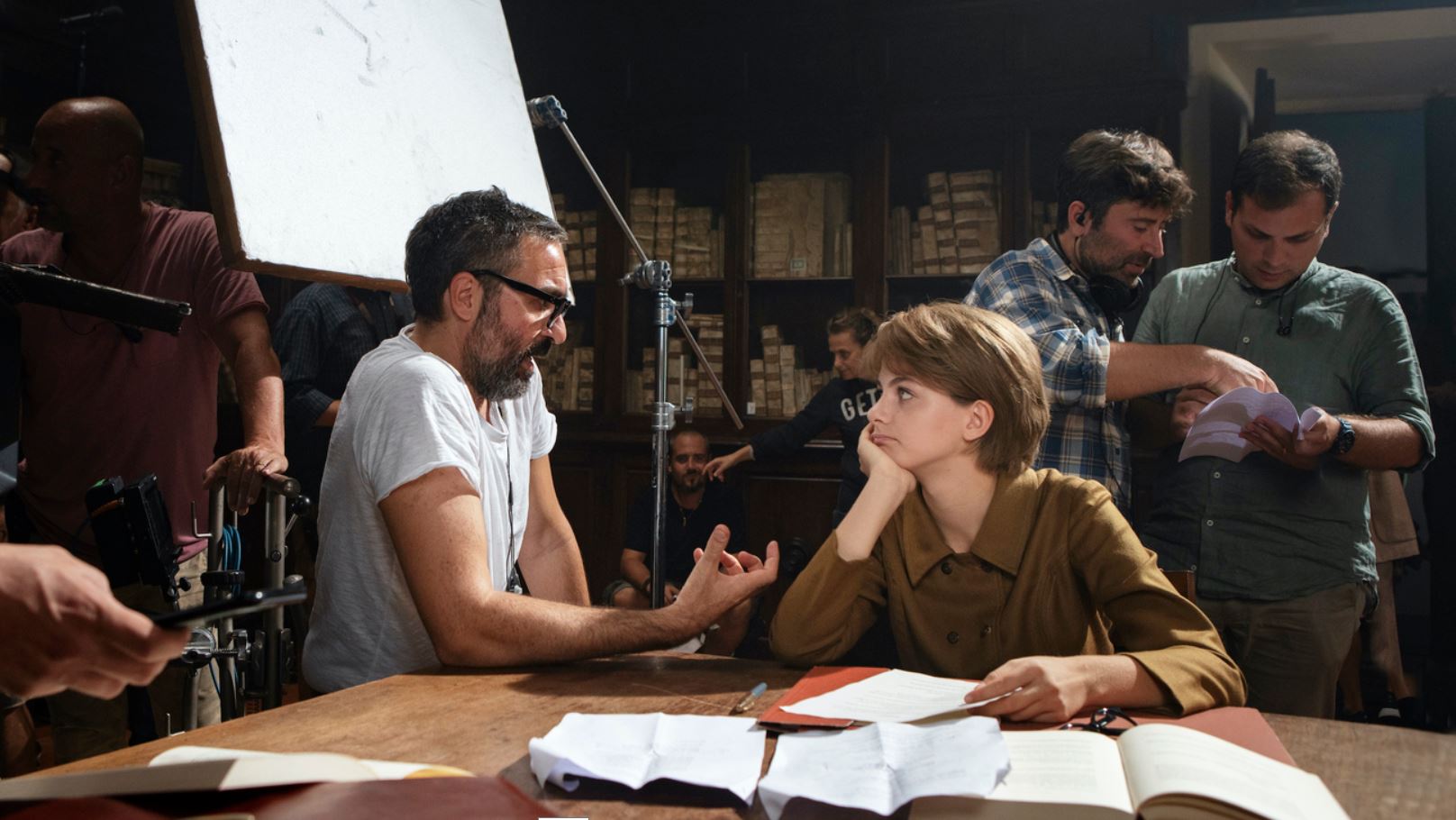
I love what you’re saying about the respectful distance. In “My Brilliant Friend,” because of that distance, the visuals are incredibly rich and layered in the foreground and background. And bringing that background to life so vividly must have been its own challenge.
Of course. Because you create a world that you put on and off. Cinema is not just [about] what you feel, think or what you think you want to do, but it’s also [about] how to do it. For example, we used a kind of anamorphic lens–and this is a very technical answer–because we wanted the background to be a character of the story. We wanted to underscore the environment. Sometimes as a viewer, I feel that [the production values of period dramas] look a bit pretentious, because there is no dramatization of the background. So with this anamorphic lens, we could be very close to the character. So we followed them and their emotions in the story, but we [also] have a wide angle, a wide view of the background that became a character.
Also, I believe there is a suggestion that is coming from the novel. [While] we just followed two stories of two persons, the background is [something that was always there, even though] it is not underscored. Of course, I’m Italian, so for sure, it’s much easier for me [to see]; it belongs to me, it’s my history, it’s the history of my country. [But] you have the feeling that you really are leading in this period of time, because you are always attached to characters. And from a close up, you have another story on the back. For me and my team, it was a challenge. Because we had to find extras with the same kinds of faces. We had to teach them how to walk, how to move, how to react. The work with the extras is an artistic kind of work. And after four years, after two seasons, these guys became a crew, you know? Because they lead the neighborhood and they are a part of the story itself. And now I can say, they are professional actors, even if they are extras. Because each one of them is following his own character. Each one of them has a name, has a house, has a life. So when you see the background, we know where this guy is going, and he knows where he’s going. It’s a chore but this is the work we did to make it as authentic as possible.
It’s fascinating to watch the cinematic tradition evolve in the second season. You don’t abandon anything stylistically as the story propels the characters forward, but perhaps there is another added layer there. The start of Season 2 Episode 7 for instance, where Lenù and her boyfriend Franco (Bruno Orlando) run through the streets of Pisa and come across protestors, felt very French New Wave to me in its energy.
Exactly. In the second season, [the characters] start to run. They make decisions. They leave the neighborhood. And then there is the colonist boom in the ’60s in Italy. It was a rich country. So there was a real enthusiasm in the air. So I asked myself, “how can we be part of that change with the camera, with cinema, with the image?” And then I saw myself as the guys of the Cinémathèque in Paris, like [François] Truffaut, [Éric] Rohmer, [Jean Luc] Godard. And what they did in the ’60s, at the beginning is, they cut the tradition of cinema, of the previous masters like [Roberto] Rossellini. The camera was mostly handheld and they were going into the city and it was very demanding. There was something very dynamic [about it]. It was the opposition to Neorealism, that is very stable [stationary]. Neorealism was a very rigorous kind of cinema; very serious in the way cinema approached the subject. There was a fear as well, that it was just to tell stories of a young guy trying to make a difference.
So the [New Wave] tradition from these guys of the Cinémathèque with the second season, to feel the same kind of enthusiasm, the dynamism of the period. And again, what’s magical about the books is the [change was suggested in them]. Even the way they talk is different from the first book to the second. The situations that they deal with are very different. So the story from Ferrante was really set in that time and you feel the writing is authentic as well. [With that S2E7 scene], because the relationship with Franco is articulated over four years and we [didn’t have that time], we decided to make a kind of statement. This is a language that cinema knows very well, [with] scenes that help you to live the same kind of freedom. And in that moment, [Lenù] is with a new guy that we don’t know, but we can tell a lot of the relationship and where they are. There were a lot of protests, a lot of demonstrations of workers in the time. And so we see that the ’68 is coming, the revolution is coming.
We felt that once you make a synthesis with the motion and the music and the actors of course, in five minutes, you can tell something [that you might miss] otherwise. And again, there was [the] mood of Godard and Truffaut; they were running all the time. They were going somewhere. And that was really alive for me as a director, this [intoxicating] period that was full of fantasy and imagination. And that makes the second season more articulated and complex and also less rigorous, as ’60s were much less rigorous than the ’50s.
And another cinematic moment in Season 2 [Episode 6] is the scene with Pier Paolo Pasolini [played by Enrico D’Errico], where he gets heckled with homophobic slurs. We get to grasp the difference between Lila and [her boyfriend] Nino in that moment; feel it’s a doomed romance. Did that come from the book?
In the book, the scene was set in a library and not in a cinema and it was very different from the one shown in the series. Lila’s attraction to Pasolini was important to me, because both of them, in a sense, put the body at the center of their sacrifice, their rebellion. As Pasolini did, Lila knows how to look beyond, where others “still” are unable to see anything. Intelligent, highly educated visionaries; they adhere to reality. In remaining anchored to the earth, to the suburbs and watching over the forgotten ones.
This is the story of female friendship, but also, it’s the story of class in Italy. A lot of that is universal, but there are details there about the North and South divide in Italy. In one of the Pisa episodes, Lenù gets insulted because of her background. Was that specificity was a challenge to adapt for an international audience?
Yeah, I believe that is quite universal. I mean, of course, there are many things [and nuances] that are literally Italian. But the story works very well even internationally. So once you see her [Lenù] being humiliated by guys, [you understand] because they are from the North and maybe they are richer, and she has that dialect from the South. In the sixties, going from the South up to the North was very, very rare. We are talking about just a few people [who managed to do it]. South was very poor and education was not something that everybody could assert to. So the fact that she talks with some kind of accent is something that may be lost internationally by the viewers [due to language]. But being humiliated, because you feel apart from the reality you are [used to] living [in] is something universal that everybody can understand. I sometimes think about American cinema [that way]. Even though I am not American, I can always find something that is the same in my country.
There are a pair of sexual assault scenes in the series. I thought they were done and filmed responsibly, as the focus was on the women’s shame, resignation, and sadness. Can you talk about your approach to those scenes, especially the one with Lila, as I feel sexual assault is often mistreated visually in cinema?
My instinct is to force myself [to understand everyone]. My responsibility as the director is to not judge any of the characters, and to understand everyone; that’s part of the deal. You have to force yourself. In the case of, for example, Stefano Carracci [Lila’s husband], that scene was very brutal. But somehow, there is [also] a lot of sadness. Because in my opinion, I did not describe the man, the assaulter, as a monster. I know him since he was a kid. I know him from the first episode. [He was] from a family where violence was the only language. So for that man in the ’60s, uneducated, coming from the South of Italy, that is the way their parents have been told to act. So once you force yourself, you understand that he’s like an animal who doesn’t have the instruments, the words to talk.
And of course, your point of view is the woman who’s being assaulted by him. And again you create a kind of crash where you don’t hate anybody, but you just feel pity. And that feeling is what [makes] the viewers to feel the real violence, which is not sensationalistic. It is not to show off the violence just to impress you. We tried to make something where if you cry, you cry for the violence itself. So you just let the people be free to experience the real violence deeply; something that makes you cry not by anger, but another kind of feeling. You don’t go anywhere [with anger]. You won’t understand anything. You just look at the film with a feeling of pity. Then the scene grows inside yourself. And the point of view is [the woman that’s being assaulted]. It’s always their point of view. That’s crucial.
You directed pretty much all the episodes, except for a pair in Season 2 that were done by Alice Rohrwacher. How did she become involved? While her episodes are in synch with the series, I felt they are their own thing stylistically. A little dreamy, a little surreal. You see her filmmaking sensibilities in them.
And that was my goal. I asked her to shoot the episodes in Ischia, because the story in that moment between the girls is the story of a fracture. I mean, they basically split up and nothing would be the same. So, I [thought] instead of artificially making myself [capture the fracture], why don’t we ask someone else that is different? I didn’t ask Alice to follow my way of shooting. I asked her to look at that story with her eyes. The closer she [would stay] to herself, [to her point of view], the more [pronounced] the fracture in the series [would be]. So then I would come right after following the fracture she paved.
In TV, they use a lot of directors and they ask the directors to [make] each [episode] like the other one. Because you have to make a series and you are not much into the point of view of the director. It’s more specific to cinema, following the director. And I was trying to say something different there. I was not interested in sharing the series with someone who was going to replicate what I did. I just asked her. I like the fact that the form is the same, the music and the grammar is the same. But if you take a deeper look at the two episodes of Alice, you clearly understand there is a difference. So what I asked her is to be there with her own look, again, to respect [her] as the director. If you see [directing] as an artistic job and a way of looking, you have a responsibility to defend [the] point of view.
And this also explains why “My Brilliant Friend” is cinematic in a way that I’m not all that used to seeing on TV. I look forward to seeing more of that in Season 3. There must be a lot of timing uncertainties right now though, with the pandemic going on. Still, what can you share with us regarding the upcoming season?
Yes, because of Covid-19, we still don’t know when it’s going to happen. We are asking ourselves all the time. The third season is in a very dramatic period of time in history, the ’70s. Because the ’68 revolution has failed and terrorism grows in Italy during that time. So we’re coming from the ’60s, and slowly, slowly, going to get into something different. The stage becomes an apartment [in the new season] and the house [interiors] really look like quarantine somehow. Words, dialogues [become] very important, because people start to talk about everything. They start to [constantly] interpret [things] to find a reason why. In the ’60s, it wasn’t like this. People were just leaving [the house], just going outside. There was still the fresh feeling of the war. In the ’70s, again, the stage is an apartment.
And you know, I feel that the best of the cinema culture that [happened] during the ten years that we are talking about is the New Hollywood. The cinema of [Martin] Scorsese, [Brian] De Palma, [Francis Ford] Coppola. And if you think about their films in this time, they were all very claustrophobic. Like Coppola’s “The Conversation,” or “Three Days of the Condor” or even “Kramer vs. Kramer“… And even if “Taxi Driver” was the story of a guy that was going around in the city in a cab, the horizon in front of the viewer was getting darker. So you stay home, trying to build a new way of leading a modern life. And what you’re going to see then is this kind of epic, which is, in my opinion, very interesting because it’s very different from what we saw before. But it’s very challenging because something else is really coming. Because terrorism is outside, and people were afraid and they start to be more inside. And I believe that the good, artistic directors of that time were kind of following that same feeling, [the feeling of] fear. There was a lot of fear [in the air]. And also, whatever they idealistically hoped with the revolution was failing. So there was a lot of anger coming out. And the third season is going to be the mix of that.

