
 “Home Movies” (1980)
During Brian De Palma’s sexy, suspenseful streak of either out-and-out masterpieces or interesting, adventurous entertainments, he stopped to make “Home Movies,” a clunky, low-budget, disarmingly autobiographical comedy about a young man (Keith Gordon) who, distraught over his parents’ rocky marriage, starts obsessively filming his home life. (Some of its handmade charm came from the fact that De Palma made the movie with his students from a class he was teaching at Sarah Lawrence College). Voyeurism has been a constant theme in De Palma’s work, stemming from an early childhood incident where he tried to capture photographic evidence of his father’s philandering ways. This is De Palma dealing with that situation directly, although diffused through the trappings of a gonzo indie comedy, wherein the Gordon character is visited regularly by Kirk Douglas (who had just starred in De Palma’s infinitely funnier big-budget sci-fi thingy “The Fury“) playing a kind of magical film professor who guides Gordon in the best ways to photograph his father. Sometimes this is kind of funny, but more often than not it’s WTF-worthy weirdness. De Palma regulars Nancy Allen (who was still married to the director at the time) and Gerrit Graham (from “Phantom of the Paradise“) make memorable appearances but get lost in the muddy, boxy photography (so weird for a director who usually so elegantly uses the widescreen image) and snared in the script’s confused tonal mishmash. De Palma movies are often notable for being wholly understandable just by the images alone; even without music or dialogue you can grasp what’s happening. With “Home Movies,” he was boldly reverting back to the more experimental material of his early films but in a way that fails to connect in any meaningful way. He was certainly going for something with “Home Movies,” but what that something is remains wholly obscured. Not even the imagery can muster much enthusiasm, even from the De Palma faithful. [C-]
“Dressed to Kill” (1980)
We could describe the plot of “Dressed to Kill” in detail, but the story isn’t really the point here for either the director or his audience. De Palma’s love for and homages to Alfred Hitchcock have been discussed to a brutal, stabby death, but it’s impossible not to bring up the original Master of Suspense when talking about this particular movie. We imagine it’s the film that De Palma thinks Hitchcock would’ve made were he not operating under the Hays Code. Echoing one of Hitch’s most famous scenes, this 1980 film begins with Angie Dickinson’s Kate Miller in the shower having a rape fantasy, and the film isn’t shy about showing every inch of the actress (or, more accurately, body double–and Playmate–Victoria Lynn Johnson). While Hitchcock’s shower scene doesn’t show the blade piercing the skin, De Palma’s murder later in the film zeroes in on a slicing blade and glories in the spurting blood from the first strike — what a difference two decades makes. Beyond the individual moments, there are of course thematic and stylistic echoes, including doubles, voyeurism and blondes (there are apparently no brunettes in De Palma’s New York). But outside of the easy comparisons to the classic filmmaker’s work, “Dressed to Kill” stands on its own as a fun, sometimes silly psychosexual thriller that only De Palma could have made. The film is steeped in the year 1980, and many of its elements haven’t aged particularly well (it’s not one of Michael Caine’s best performances), but it is still an enjoyable exercise in style. Ann Roth deserves extra notice for creating the glamorous costumes, particularly for Dickinson’s sexually frustrated housewife and Nancy Allen’s upscale hooker. [B+]
“Blow Out” (1981)
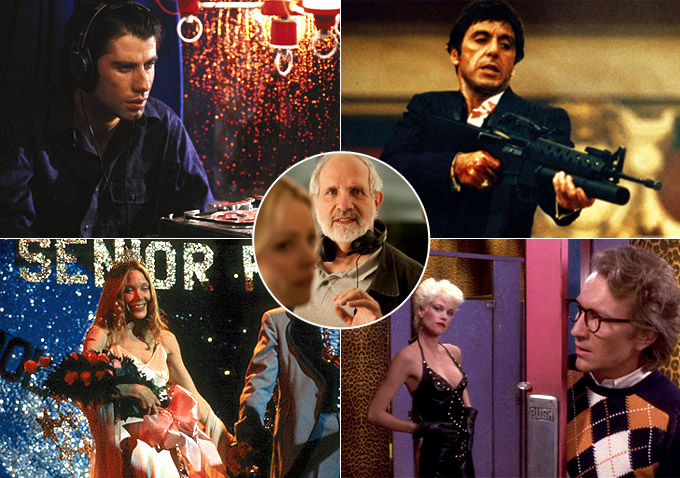
No matter what you think of De Palma’s oeuvre as a whole, it’s impossible to deny the raw power of “Blow Out.” An uncanny bouillabaisse of influences including everything from Antonioni‘s “Blow-Up” to the JFK assassination, the movie concerns a B-movie sound technician (John Travolta, in his all-time best performance) who accidentally records a political assassination and gets involved in a dark conspiracy involving a young call girl (Nancy Allen, of course) and a contract killer (John Lithgow, of course again), who lets his work get away from him. “Blow Out” oscillates wildly in terms of tone and genre, too. Ostensibly, it’s a thriller, but it’s also a movie-world satire about low-budget filmmaking, and a celebration of the transformative power of cinema, all nestled inside regular De Palma themes of voyeurism, sexuality and political unease. What was originally intended as a much smaller film wound up with an infinitely larger budget thanks to the rising star power of Travolta and the movie, according to one De Palma book, made less than half of its production back in its initial domestic run. It’s hard to imagine audiences, who had been so beguiled by Travolta in “Saturday Night Fever” and “Grease” turning up to see him as an obsessive, self-loathing sleazeball. (The movie, although released in 1981, carries with it the cynicism and sophistication of a seventies movie. Had it been released just a few years earlier we have to believe it would have been more loudly appreciated and seen by a greater audience.) But really, its cheif pleasure is that if “Blow Out” is consumed with the mechanics of filmmaking, then the filmmaking in “Blow Out” is beyond exquisite. From the opening prologue, a phony slasher movie sequence that is giddily over-the-top, to the title sequence that basically lays out the entire movie in a few minutes, to the staging of the actual blow out; this is De Palma’s working at an astonishing technical level, but without the usual glittery flourishes that usually garner so much criticism from the director’s detractors. It is, in its weird way, subtler than most of De Palma’s thrillers but just as dazzling, maybe more so (Quentin Tarantino may have repurposed a section of it for “Death Proof,” but even Pino Donaggio‘s score feels delicate and understated). There are showy moments, of course, like the sequence where Travolta realizes his tapes have been erased, all captured by a single swirling camera movement, but it’s all in service of a deceptively simple story of growing paranoia and sexual unease. “Blow Out” culminates in what is undoubtedly De Palma’s most downbeat ending; (SPOILER) not only does the beautiful girl get horribly murdered but our “hero,” racked with guilt, who has been recording the entire moment, ends up utilizing it for one of his hacky B movies. In De Palma’s world, even real-world tragedy can be fodder for movie magic. [A]
“Scarface” (1983)
A 1983 retelling of the 1933 Paul Muni gangster classic, DePalma takes on the American dream and renders it absurd (and violent) in the form of Cuban immigrant Tony Montana (Al Pacino). The gangster genre has long been a useful way to dissect the American dream, especially for those ethnic immigrants shut out of the mainstream capitalist system who found access to financial success (the marker of achievement) by turning to crime. The 1933 version of “Scarface” was so violent that it, in part, inspired the restrictive Hays Code, enforced in Hollywood in 1934, that required films have “compensating moral values” for depicting crime, lawlessness, and general immorality (ie. the bad guy’s got to be punished). And DePalma’s take follows the gangster formula dutifully, down to the bloody blaze of “compensating moral values” that he goes out in. Written by Oliver Stone in the wake of a fierce cocaine addiction, the film is like the effect of a line of fresh powder snorted in a Miami club bathroom: colorful, bright and bloody. Pacino disappears into Tony, his accent thick and unwieldy, his eyes wild. He is unhinged and unpredictable, a man who lives by the motto he sees on a Goodyear blimp: the world is yours. An exquisite Michelle Pfeiffer represents his ultimate trophy: an icy blonde white woman, whom he gets how he gets everything in his life—with copious amounts of cocaine. But while Tony’s creeds and lifestyle are often aped in rap videos as an aspirational way of life, make no bones about it, “Scarface” is an absolute satire of the fallacy that is this particular American Dream. At the moment when Tony throws a tantrum in a fancy restaurant, sipping expensive wine, surrounded by his drug-addled trophy wife and his best friend Manny (Steven Bauer), he realizes that all that he’s worked (and killed) to attain is utterly empty and meaningless. Tony Montana is capitalism’s existential crisis. A close reading of the film clearly demonstrates how De Palma illustrates this—even the famous bathtub scene shows Tony alone and made absurd by his own meaningless surroundings. The epic scope of the film, the South Beach sun-blasted, saturated colors, the brutal violence, and Pacino’s over the top, but brilliant, performance have co-mingled to create a gangster classic that wasn’t embraced upon release, but has since imprinted itself on our collective unconscious. [A]

