
What was the moment where you decided you absolutely must make films?
I was planning to shoot this film when I was 24, but I could not find investors. Then my college teacher Mr. Edward Ding says he’s willing to give me this amount of money to help me. I was moved by his no-returnable donation; at that time I made my mind up to begin making my film. He became the executive producer on this film.
This is a China I’ve never really seen on film before. I feel like I was able to open a window and look at someone else’s life, far away. I am most taken by how the entire landscape is fighting with time. Everywhere we look there are buildings that are half built or half collapsed. Did you set out to make a film capturing a moment in time for your country? Or did that happen to emerge coincidentally from your story?
I think it is just a coincidence. All my thoughts about the film are not coming from times and countries. My film is only talking about time, memory and dreams.
 You are Miao [an ethnic group mostly centered in the Southern mountains] Chinese. Was there an aspect of Miao identity you wanted to explore?
There is Miao identity in my blood, so I have an unforgettable feeling to it, and it exists in my film indistinctly. But I don’t want it to be the theme of my film, so I am always trying to avoid making my film to be a fake folkways culture thing.
Your movie takes us to a village called Dangmai. Is it a place you knew well, or a place you found while thinking about your story?
Dangmai is an unreal place, which I created in the script; and I hope it is a secret place. Before shooting, I found a small village, near Kaili, which is called Ping Liang. My wife was the production designer for the film; she did some design work at that village. I made some amendments in the script for the long take; these changes were made according to the location and space in that village, which became much more suitable for shooting.
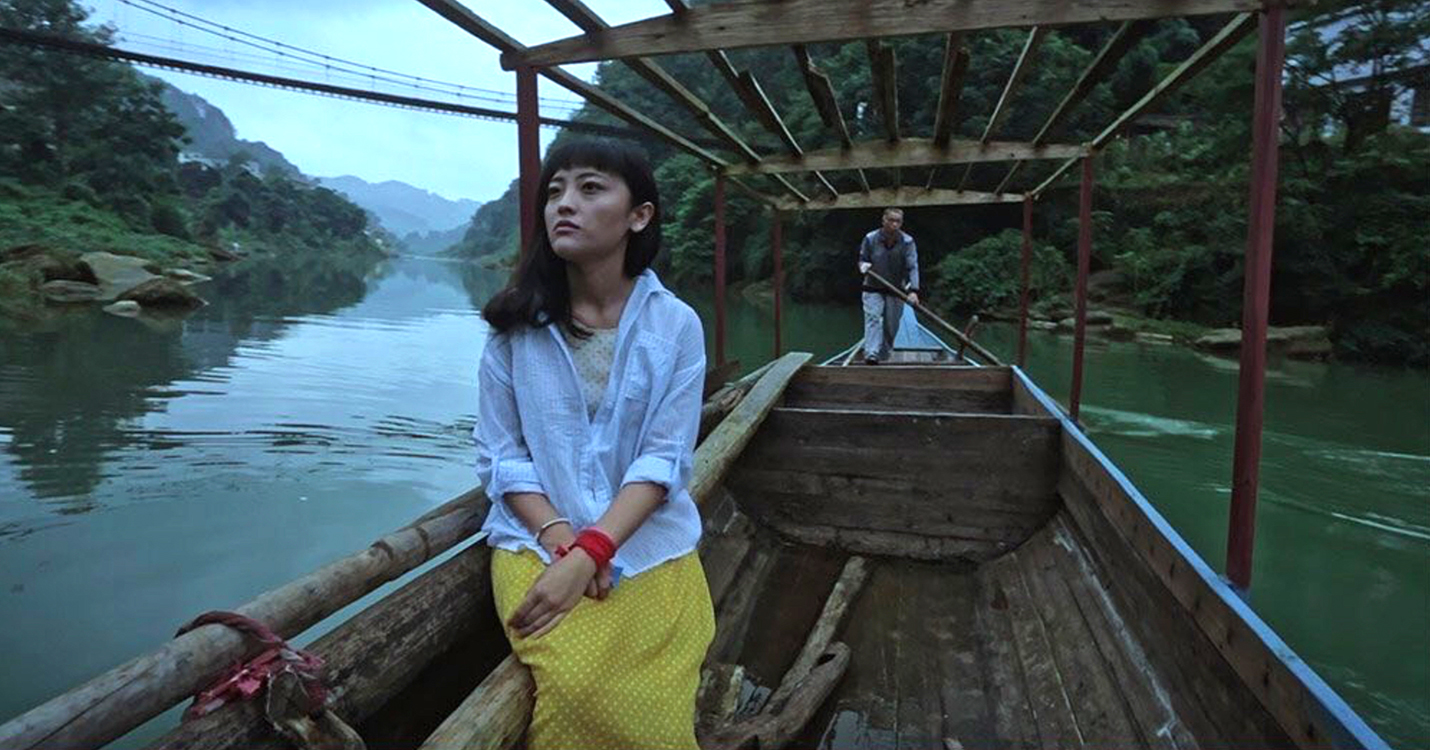
The centerpiece of your movie is a miraculous 41-minute single take that defies description and made me feel as if I was slowly levitating out of my seat and that anything was possible in cinema again (sometimes I forget). I don’t want to ask you about anything technical about the shot. I prefer for it to remain a mystery (and there are places online that give away your technique). Instead, I want to ask you about a cat that appears near the end of it. Do you know which cat I am talking about?
Haha! That rooftop is a balcony, the cat plays there everyday. I spent half a month to rehearse this long take, so I think not only the village people, but also all these animals got used to it. Since it was there during rehearsal, I wanted it to be recorded in the film.
Isn’t it strange how many animals came to visit your film? Did you direct these animals, or did they impose their will upon the movie?
The dog showed up in the beginning of the film and it appears several times during the film, it is quite hard for me to control it every time. In my film, sometimes animals are marks about memory; sometimes they are only guest actors. In fact, there are many animals, such as, dogs, cats, birds, bugs, and horrible snakes in Kaili, so I made sure to have them in my film.
Here is a video made by Chris Marker in 1994, when you were maybe four years old, which may be the world’s first Internet cat video.
Thank you! I watched it three times.
Did you ever feel like the shot was impossible? Did it ever feel like you knew it was possible but everyone else doubted it?
I had the confidence to finish this shot, no matter how hard it will be. As filming, it was not to finish a mission; instead it is a 40-minute experience to all my crew and me. It’s more like we shared the same experience as the actors.
How did you convince other people, so many of them who aren’t film professionals, to share your dream of this shot?
At that time, all of us felt we could not finish it. Especially challenging was the necessity of my aesthetic. Now, we all regret that we could’ve done better at that time.
How did you feel once it was finished?
After finishing this long take, I didn’t feel ease at all, as the crew was dismissed due to lack of budget. For me, the hardest period just began; because the film was only finished 70 percent after this long take. Therefore, after this shot, my first reaction was to get some rest, to recover my energy and my passion. And then, I set up a four-member group to finish the film, including my sound engineer, my assistant director, and my wife. We together finished all the train parts, and I am very satisfied about these parts. I borrowed a smaller and easier to carry machine: The Blackmagic Pocket Cinema Camera, but it is very hard to control well.
This film helped you travel the world, showing it at festivals. Was it your first time traveling the rest of the world? Did it give you new ideas for films?
Yes, this is my first time to travel abroad. I don’t like traveling actually, all these trips make me very dizzy, and it didn’t inspire in me new ideas about filming, but it did give me some new experiences about art. For example, for me in Kaili, painting is just like flat patterns, but when I visited the Musee d’Orsay, I saw pieces from Van Gogh, and every single brush [stroke] seems like narrow escape. I felt that all creators were the same globally, and I am deeply touched by it.
Can you give us a hint for the future of what you’d like to make?
The next project is a time and memory detective story, which takes place in the countryside. I will have a chance to work with some Chinese filmmakers who I admire very much and they will be my main crew, which includes cinematography, sound and design. I think only to keep my focus purely on filming; it’s the way I show my respect to you and all my audiences.
“Kaili Blues” is playing at NYC’s Metrograph cinema. Additional U.S. dates are available on Grasshopper Films’ website.
This interview was edited for translation. — Aaron Stewart

