
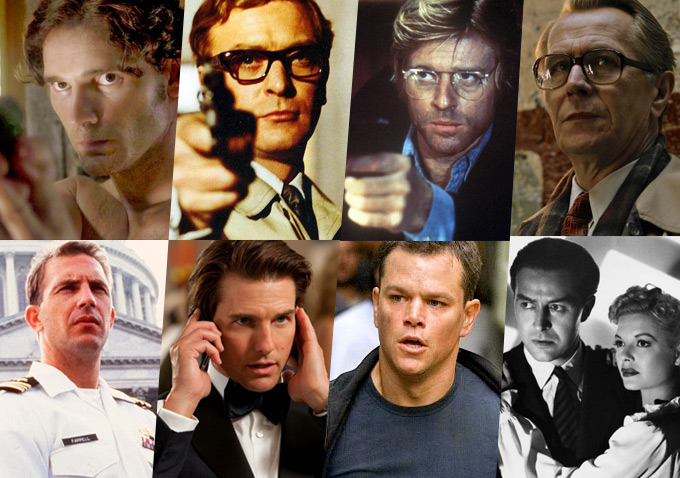
 “The Ipcress File” (1965)/“Funeral In Berlin” (1966)/“The Billion Dollar Brain” (1967) — Harry Palmer
Known as the “anti-007,” a darker, less suave anti-hero spy, the Harry Palmer of the Len Deighton spy novels, adapted over the course of three films by original Bond producer Harry Saltzman, was immortalized by Michael Caine as a roguish insubordinate, but one who got the job done nonetheless. Sidney J. Furie’s “The Ipcress File” is criminally underseen even by spy film aficionados, perhaps because its slight ending robs it of A+ status, but it has evocative style to spare. Shot by Otto Herller (“The Ladykillers” “Peeping Tom”), it is one of the best-looking spy films ever; one could dedicate an entire One. Perfect. Shot. twitter account simply to frames from this film, and the exotica score by John Barry is an overlooked classic. Directed by 4-time Bond director Guy Hamilton (“Goldfinger”), “Funeral In Berlin” is stylistically joyless in comparison thanks to the oppressively grim post-Wall mood of East/West tension, but it was groundbreaking at the time for its darker, paranoid tone compared to fluffier spy movies. Finally, surprisingly helmed by maverick Ken Russell (his only studio gig) ‘Billion Dollar Brain’ is the least successful of the bunch, but that’s more to do with the janky plot, featuring a supercomputer as the villain and a jingoistic Texas tycoon pulling the strings. Russell certainly gives the film moments of vivid pleasure, from its super-stylish opening credits to its orchestral score with outre psychedelic elements. Bonus tidbit: the movie’s femme fatale, a first for the series, was played by Françoise Dorléac, the older sister of Catherine Deneuve.
“The Lives Of Others” (2006)
A melancholy, thoroughly unglamorous take on the genre, Florian Henckel Von Donnersmarck’s film saw German cinema cast a look back at its own recent history when the country was divided and spying on itself. Set in 1984 in East Berlin, it sees Stasi agent Gerd Wiesler (Ulrich Mühe, who sadly died just as the film was reaching international audiences) assigned to surveil playwright Georg Dreyman (Sebastian Koch), because a party official is in love with the writer’s girlfriend, Christa-Maria (Martina Gedeck). The film’s plotted like a thriller but rarely feels like one, with a lyrical, novelistic tone that gives all of its characters, even the villainous Stasi superiors, an interior life, and mostly underplays any potential sentiment (though it sometimes over-eggs the ‘redemptive power of art’ pudding). Koch and Gedeck are both terrific, but it’s Mühe’s performance, sad-eyed and desperately lonely as his sole conviction — in the Party — begins to crumble, that still haunts nearly a decade on. Von Donnersmarck sadly hasn’t lived up to his promise (lousy Angelina Jolie/Johnny Depp vehicle “The Tourist” is his only film since), but if you’re going to be remembered for something, be remembered for this.
“The MacKintosh Man” (1973)
If duplicity, deceits and double-crosses mark the spy film, then writer Walter Hill and director John Huston certainly took those ideas to heart in the elaborate spy thriller, “The MacKintosh Man,” which stars Paul Newman as British spy Joseph Rearden, posing as an Australian in England (with maybe the worst half-assed Aussie accent of all time). In order to infiltrate a group of jewel thieves, Rearden is directed by his MI6 boss (Harry Andrews) to get himself imprisoned so he can get on the radar of the real criminals. But he’s being played — it’s all a ruse to gather intel on an English politician (James Mason) who is actually a Russian spy. As overly complex and sometimes overfamiliar as the plotting is, ‘MacKintosh’ benefits from Huston’s crisp, solid direction, a Euro-flavored score by Maurice Jarre and the insouciant charms of Paul Newman. Plus it’s shot by Oswald Morris, who also shot the superior “The Spy Who Came In From The Cold,” so visually, it has great texture, making good use of shadow and drab color. Certainly the talents of Hill, Huston and Newman do suggest something more classic, but ‘Mackintosh’ is still adequately entertaining within the genre.
READ MORE: Ten Romantic Spy Thrillers
“The Manchurian Candidate” (1962)
The brainwashing/sleeper agent/paranoia movie by which all other brainwashing/sleeper agent/paranoia movies are judged, John Frankenheimer‘s deliriously fun but also eerily unheimlich “The Manchurian Candidate” is a stone-cold classic for a reason. Actually, for many reasons, among them Angela Lansbury‘s brilliant turn as the cunning, quasi-incestuous anti-mother, the vivid black and white photography from Lionel Lindon, and the astringency of its satire, which felt shockingly prescient at the time, especially as the film was released less than a month before the Kennedy assassination. Also starring Laurence Harvey and Frank Sinatra as the shellshocked Major who gradually pieces together the conspiracy to place a communist puppet in the White House, the film’s real strength, however, is its story: a deliciously convoluted, morally murky tale from Richard Condon‘s novel that both preys upon and lampoons the fear climate of post-McCarthy Cold War politics. Along with “Seven Days in May,” “Seconds,” “The Train” and “Birdman of Alcatraz,” ‘Candidate’ proves Frankenheimer’s is one of the greatest 1960s filmmaking resumes of them all.
“Mata Hari” (1931)
Completely ludicrous and bearing no relation to historical fact (bar that exotic dancer Mata Hari was convicted of spying for the Germans in WWI and executed), this wildly OTT melodrama is still terrifically watchable thanks to a defining Greta Garbo performance, Cedric Gibbons‘ art direction, and the astounding costumes by genius designer Adrian. Clad turban-to-toe in sequins and sparkles and garments with odd, suddenly revealing slits, Garbo basically creates and perpetuates the myth of Mata Hari here, stretching pre-Code morals to their limit by playing her as an unrepentant arch manipulator and seductress, whose only downfall is falling for the callow, pining Russian pilot (Ramon Navarro) from whom she steals secrets. George Fitzmaurice‘s direction is never more than adequate, but by the time the exquisite absurdity of the finale rolls around (in which death row wardens conspire to make Navarro’s temporarily blind pilot believe the prison is a hospital and Mata is going to an operation rather than her execution), you’re so dazzled by Garbo that it doesn’t really matter.

