
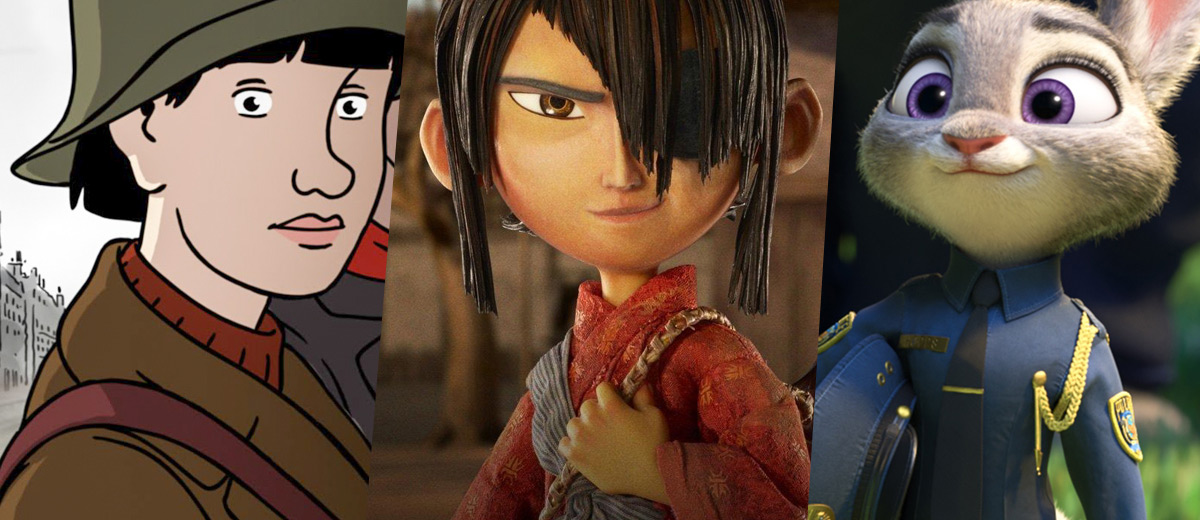
 5. “My Life As A Zucchini”
Despite its slight, barely over-an-hour running time, cutesy title, and gorgeously quirky animation, there is a shade of darkness that permeates the gently dramatic “My Life As A Zucchini” — the only title on this list not only to be a potential Animated Oscar contender but also to be one of the hottest tips for a Foreign Language Oscar nod, too (it’s Switzerland’s official entry). The story follows the titular “Zucchini” (which sounds more poetic en francais, or indeed U.K. English, as “courgette”), who is sent to a group home when he accidentally kills his alcoholic, single mother. Set mostly around the institution, the sensitive script by Céline Sciamma (the director of the wonderful “Girlhood”), which is based on the book by Gilles Paris, follows Zucchini as he navigates the personalities and forms a tight bond with the equally troubled children around him, all wayward for reasons ranging from sexual abuse to abandonment, with the screenplay rather deftly allowing the audience to fall into the rhythms of their day-to-day lives. Indeed, even with the singular, primary-color animation by Claude Barras, there is a depth of authenticity to the drama and the wide-eyed hope it embraces. “My Life As A Zucchini” trades on a message we’ve heard before — that no child is beyond is saving — but spins it with the kind of warmth and charm that’s rare.
4. “Moana”
“Moana” was touted as a spirited return to the brassy, Broadway-style Disney musicals of yore — albeit with a modern twist. John Musker and Ron Clements, the masterminds behind the best Disney animated films of your childhood (“The Little Mermaid,” “Aladdin,” “Hercules,” etc.), were chosen to direct the film, and found an amazing creative confederate in Broadway phenomenon Lin-Manuel Miranda, who provided the music and lyrics for the production. But that’s not the only innovation: Instead of the lead character following the well-established “princess” model, she is instead a born navigator, a headstrong girl unencumbered by tiaras or tired love interests. As is typical in the post-Lasseter era of Walt Disney Animation, she does, however, come equipped with a mismatched sidekick: this time, a cocksure demigod who sounds a lot like 2016’s highest-paid movie star Dwayne “The Rock” Johnson. “Moana” is a rousing, catchy and heartfelt tale of an empowered girl, a free spirit who bucks the status quo, charts her own course, finds her destiny, and saves her island from oblivion, and while it would have certainly been powerful had the election swung the other way (it was released just weeks afterwards), maybe the movie means even more in a post-Hillary world. It’s a reminder for girls too young to understand what’s going on that being strong isn’t a bad thing and that men (even demigods) can’t push you around when you truly understand your worth.
3. “Your Name”
As far as international exposure goes, it’s often hard to see beyond the all-conquering (and wonderful) Studio Ghibli when it comes to the anime tradition. But within Japan, it’s a far more diverse category with a broad audience: Not all successful Japanese animes are family films. Makoto Shinkai‘s “Your Name,” already a massive hit at home, and on a current global gross of nearly $290m, is not really a kid’s film — perhaps it’s best described as Young Adult Sci-Fi — but even that category is a little misleading. Detailing an inexplicable situation whereby city boy Taki and country girl Mitsuha, who have never met, have a tendency to wake up in each other’s bodies, initially it is mostly a body-swap comedy/romance, as Taki tries and fails not to be fascinated by suddenly having breasts, while Mitsuha’s goodnatured insights help Taki out with the girl he has a crush on at work. That’s scarcely half the story, though, as in its second act **SPOILER** it’s revealed that the two are not only separated by geography but also by time: Taki is three years ahead of Mitsuha. Shades of “The Lake House” to be sure, **SPOILER ENDS** but the stunning design (especially the backgrounds and cityscapes that seem hyperreal) and Shinkai’s confident mystery storytelling make it somehow feel completely original, right up to its deeply satisfying, surprisingly touching finale. Now, if only someone would do something about that way-too-intrusive Japanese pop-rock soundtrack.
2. “Zootopia”
Who would have guessed that one of the most politically pointed films of 2016 would come in the form of an adorable talking-animal buddy-cop movie? This computer-animated caper from Walt Disney Animation Studios, about a headstrong bunny cop (Ginnifer Goodwin), forced to team up with a streetwise fox (Jason Bateman) to crack a citywide conspiracy, wound up being an allegorical powerhouse for these troubled times. The film, with nuance and compassion, tackled issues of bigotry and bias in a way that feels fresh, new, and yet digestible enough that the younger members of the audience won’t feel alienated or lost — the mystery plot is both dynamic and engaging, and the movie is absolutely fucking gorgeous to look at, with each of the mammalian inhabitants of Zootopia getting their own specialized ecosystem and the character design (by Disney whiz Cory Loftis). It feels like classic Disney but updated and modernized in the best possible ways. Tonally, it’s a dream come true, too, which largely has to do with directors Rich Moore and Byron Howard — the latter co-directed “Tangled,” and his earnestness is easily felt, while Moore, a veteran of countless “Simpsons” and “Futurama” episodes, fully embraces the satirical possibilities of this animalized society. Working together, the filmmakers ensure that “Zootopia” never strays too far into sentimentality, but is also never too busy being topical to forget to be funny and warm. It’s a timeless animated classic for right now.
1. “Kubo And The Two Strings”
Like most modern animated films, the road to Laika‘s stop-motion marvel “Kubo And The Two Strings” was a bumpy one, complete with a director swap (story artist Shannon Tindle, who was set to be Laika’s first female director, was replaced by head honcho Travis Knight) and, upon release, an indifferent commercial reception that fell below expectations. But what it might have lacked in easily marketable appeal, it more than makes up for in sheer, breathtaking artistry. The studio’s boldest combination of stop-motion and computer-generated animation yet (Laika also made the gorgeous “Coraline,” “Boxtrolls” and “ParaNorman“), “Kubo And The Two Strings” is a mystical, surprising story steeped in rich ancient-feeling mythology with an East-meets-West aesthetic all its own. It’s the story of a young boy named Kubo (Art Parkinson), who is born into a life of magic and mayhem, and teams up with a monkey (Charlize Theron) and beetle warrior man (Matthew McConaughey) to defeat his evil grandfather, the Moon King (Ralph Fiennes). Grief is a popular thematic touchstone for family films, but few tackle it with the kind of head-on, full-hearted intensity that “Kubo” does: This movie is beautiful and brutal, and full of the kind of oddball characters and esoteric specificity that the studio is known for (this is a land rich with wonder and magic, and even though its rules are never ploddingly explained, it feels honest and relatable). Previous Laika films have been good or very good; “Kubo And The Two Strings” is great. In year of top-shelf animated features, it’s easily the best — the most impressive, most emotional, and most singularly visionary.
Honorable Mentions
It felt a little incongruous to include here, as it’s hardly a family film, has significant live-action elements and is a documentary to boot, but we’d be remiss if we didn’t mention Keith Maitland‘s “Tower” as one of the most interesting and provocative uses of animation all year. Largely unfolding as a rotoscoped recreation of the 1966 sniper attack on the campus of the University of Texas, it’s a compelling way to bring eyewitness testimony to crisp, geographically comprehensible life in a way that is also a respectful acknowledgment that we can never fully experience a historical event. It placed highly on our Best Documentaries of 2016 list. Elsewhere, “Kung Fu Panda 3” beats the threequel curse and is quite the treat, while in a year even marginally less strong for French animation, we probably would have listed “Phantom Boy,” from “A Cat In Paris” directors Alain Gagnol and Jean-Loup Felicioli, too.
Dishonorable Mentions
But 2016 wasn’t all good news for animation. There were just so many that some had to be duds, right? Well, yes. Big time. Seth Rogen‘s long-in-development “Sausage Party” aimed for something between the profane and the profound, and satisfied neither. Add to that the animators’ claims that they were unfairly treated, and the whole venture left a sour taste in our mouths, despite becoming a surprise hit. Also, the movie looked about as cheap as “Norm Of The North,” an agonizingly unfunny and ugly animated feature released by Lionsgate. DreamWorks Animation‘s “Trolls,” starring Justin Timberlake and Anna Kendrick, looked great, and was fine whenever it drifted into gentle surrealism. But the rote storytelling and uninspired vocal performances left much to be desired. The worst animated movie of 2016, though, is undoubtedly “Batman: The Killing Joke,” a direct-to-home-video DC Comics release based loosely (and poorly) on the beloved Alan Moore comic book of the same name. This is a movie where Batman fucks Batgirl — and that’s the least of the indignities she faces. The movie is vile, pointless, and fails to even capture what made the (already problematic) original source material popular, let alone improve on it. But hey, at least it answered the question of where all the buffoonish gay-best-friend stereotypes went — to cash-in animated versions of graphic novels, it turns out. Care to leap to the defense of any of these? Want to berate us for missing “Storks“? Tells us in the comments.
— With Oli Lyttelton, Kevin Jagernauth and Greg Ellwood.

